By Enrico Aillaud, Founder & Lead Engineer, Yameveo
Two weeks from now, our team flies to Athens. On 26 and 27 February, the 13 partners of the VANTAGE consortium will meet in person for the first time. The kickoff marks the official start of something we have been building toward for more than a year.
I want to use this moment to explain what VANTAGE actually is, what Yameveo’s role in it is, and why this project matters beyond the EU funding announcement.
What is VANTAGE?
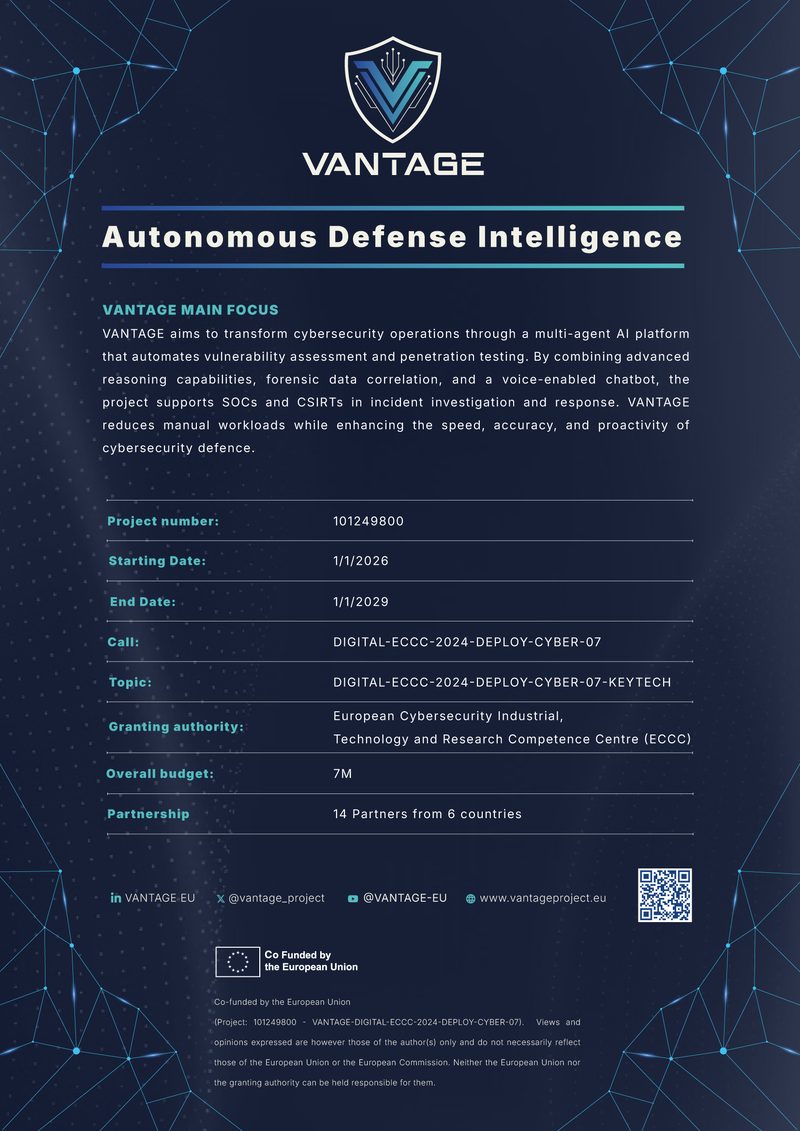
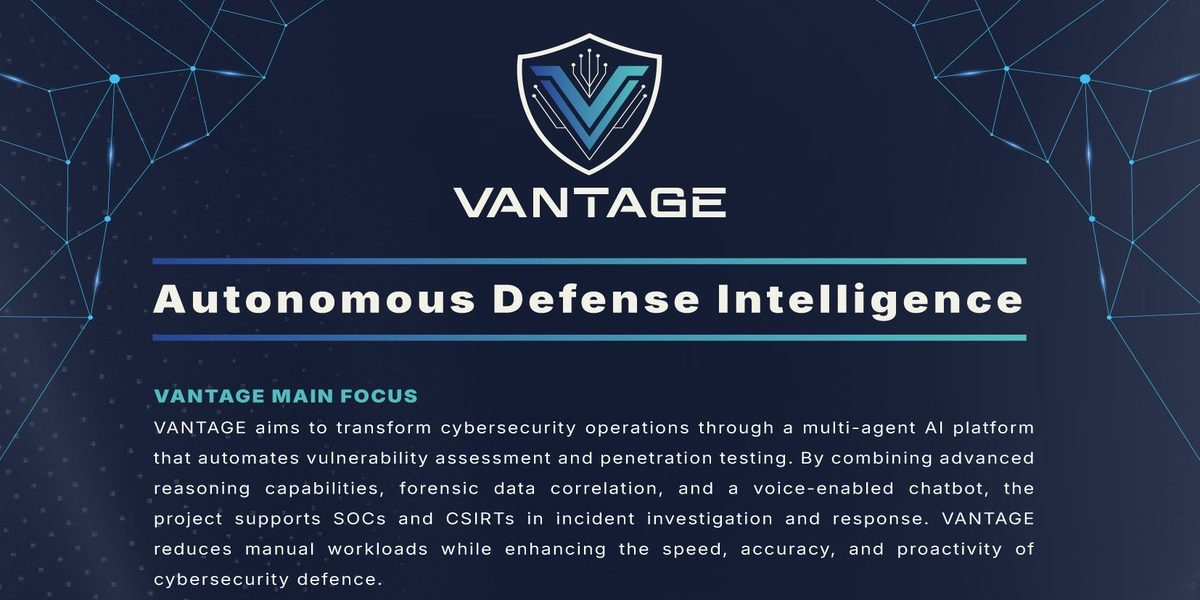
VANTAGE stands for Vulnerability Assessment aNd Testing Automation for Global Enhancement. It is a 36-month initiative funded under the Digital Europe Programme (call DIGITAL-ECCC-2024-DEPLOY-CYBER-07-KEYTECH), with a total budget of over €7 million and 13 partners from 8 EU countries.
The core idea is to build the next generation of cybersecurity tooling on agentic, multi-model AI: a production-grade system that SOCs and CSIRTs can deploy and depend on, rather than a wrapper around existing tools or a demo.
Specifically, VANTAGE automates:
- Vulnerability assessment and penetration testing (VAPT): identifying real attack surfaces rather than just running scanners
- Incident investigation: forensics, log correlation, and attack reconstruction using multi-modal AI
- SOC Level 1 operations: a voice-enabled chatbot that handles routine analyst tasks so human analysts can focus on the work that needs them
- OSINT and threat intelligence, including dark web and blockchain-based intelligence gathering
- AI-driven exploit updates: exploits pulled from ExploitDB and GitHub and standardised automatically
The consortium is coordinated by Diadikasia Business Consulting in Greece, which is why the kickoff is in Athens. Partners include national CSIRTs, university research groups, and specialised cybersecurity firms from Estonia, Slovenia, Denmark, Spain, Italy, and the Netherlands.
Yameveo’s role, and why we took it
Yameveo leads Work Package 5 (functional, operational, and testing requirements). In practice, we are responsible for making sure that the project’s AI, the VAPT platform, the incident investigation layer, and the frontend work together as one system. We also build AI pipelines that run locally, so project data never leaves the EU. WP5 is the layer that holds the project together.
We also contribute backend development to WP2 (AI systems), WP3 (incident investigation), and WP4 (VAPT). The API design connecting these work packages is ours.
We took this on because the technical problem is hard, and because we have the right background for it. We design backend systems in Python and build full-stack applications with React, and we spend as much time on system architecture and API design as on the code itself. We have worked with LangChain, Ollama, DeepSeek, Llama, and Qwen in production, not in notebooks. And we have been designing multi-service architectures long enough to know where the integration problems hide before they show up.
There is also a strategic reason. VANTAGE will produce capabilities that European cybersecurity teams need right now, particularly with NIS2 raising the compliance bar for organisations that have historically underinvested in detection and response. We expect the tooling we build here to inform the SaaS products we are developing beyond the project lifecycle.
The Athens kickoff: what happens there
The 26-27 February meeting in Athens is where the technical architecture gets agreed in person. Work package leads present their initial designs, integration points get stress-tested, and the teams that will be collaborating remotely for the next three years put faces to the names in the consortium agreement.
It is also where you find out which partners share the same reading of the problem and where the gaps are. In any project involving 13 organisations across 8 countries, some assumptions will not survive first contact with the other work package leads.
We are going in with a clear technical position on the WP5 architecture. I will report back here with what we agreed and what surprised us.
Why this matters beyond Yameveo
Europe has a cybersecurity skills gap that is not going to close by hiring more analysts. The only structural solution is automation: moving the routine work (alert triage, known vulnerability scanning, standard incident classification) to machines, so that human expertise concentrates on the novel threats.
VANTAGE is one of the serious attempts to build that automation at the level the current threat landscape requires: multi-agent AI and real forensic reasoning, rather than pattern matching against known CVEs.
Whether it succeeds depends on execution. We intend to be the part that executes.
If you work in a SOC or CSIRT and want to understand what we are building, or if you are evaluating how VANTAGE capabilities could apply to your organisation, write to me directly: hello@yameveo.ai.
VANTAGE is co-funded by the European Union under the Digital Europe Programme. Views expressed are those of the author and do not represent the position of the European Commission or ECCC.